
Montgomery County
Known species: 101
Total Observations: 9,493
Population: 535,846
Area in Square Miles: 462
People per Square Mile: 1,153
Observations per Square Mile: 17.3
Percent of State Species: 58%
Percent of State Observations: 3.1%
County iNaturalist observations
The Observed Species table provides statistical data on all odonata species that have been observed in the county. Below that is a Target Species table listing species that have not yet been documented in this county, but are likely to exist in the county. This list is data-driven by listing species records from neighboring counties.
Observed Species
Common Name | Scientific Name | Montgomery Total | Ohio Total | Montgomery 2025 | Last Sighted |
|---|---|---|---|---|---|
| Eastern Forktail | Ischnura verticalis | 627 | 18,549 | 21 | 2025 |
| Eastern Pondhawk | Erythemis simplicicollis | 555 | 19,534 | 22 | 2025 |
| Widow Skimmer | Libellula luctuosa | 501 | 14,355 | 30 | 2025 |
| Double-striped Bluet | Enallagma basidens | 417 | 6,256 | 12 | 2025 |
| Blue Dasher | Pachydiplax longipennis | 391 | 18,692 | 21 | 2025 |
| Common Whitetail | Plathemis lydia | 381 | 14,243 | 31 | 2025 |
| Fragile Forktail | Ischnura posita | 359 | 15,432 | 15 | 2025 |
| Eastern Amberwing | Perithemis tenera | 296 | 12,693 | 18 | 2025 |
| American Rubyspot | Hetaerina americana | 287 | 5,250 | 43 | 2025 |
| Common Green Darner | Anax junius | 278 | 6,289 | 27 | 2025 |
| Blue-fronted Dancer | Argia apicalis | 248 | 7,716 | 25 | 2025 |
| Ebony Jewelwing | Calopteryx maculata | 241 | 10,084 | 28 | 2025 |
| Halloween Pennant | Celithemis eponina | 224 | 5,028 | 16 | 2025 |
| Stream Bluet | Enallagma exsulans | 204 | 5,543 | 14 | 2025 |
| Powdered Dancer | Argia moesta | 195 | 6,026 | 12 | 2025 |
| Midland Clubtail | Gomphurus fraternus | 194 | 1,012 | 4 | 2025 |
| Familiar Bluet | Enallagma civile | 180 | 7,430 | 7 | 2025 |
| Violet Dancer | Argia fumipennis violacea | 179 | 8,693 | 12 | 2025 |
| Black Saddlebags | Tramea lacerata | 174 | 4,110 | 13 | 2025 |
| Prince Baskettail | Epitheca princeps | 158 | 3,264 | 10 | 2025 |
| Autumn Meadowhawk | Sympetrum vicinum | 149 | 10,593 | 17 | 2025 |
| Calico Pennant | Celithemis elisa | 144 | 3,706 | 5 | 2025 |
| Blue-tipped Dancer | Argia tibialis | 141 | 5,374 | 22 | 2025 |
| Twelve-spotted Skimmer | Libellula pulchella | 135 | 4,080 | 9 | 2025 |
| Wandering Glider | Pantala flavescens | 118 | 1,903 | 13 | 2025 |
| Cobra Clubtail | Gomphurus vastus | 109 | 486 | 1 | 2025 |
| Blue-faced Meadowhawk | Sympetrum ambiguum | 108 | 1,926 | 17 | 2025 |
| Azure Bluet | Enallagma aspersum | 108 | 2,863 | 5 | 2025 |
| Spotted Spreadwing | Lestes congener | 104 | 1,069 | 6 | 2025 |
| Skimming Bluet | Enallagma geminatum | 98 | 4,461 | 1 | 2025 |
| Swift River Cruiser | Macromia illinoiensis | 96 | 837 | 9 | 2025 |
| Rapids Clubtail | Phanogomphus quadricolor | 94 | 445 | 10 | 2025 |
| Carolina Saddlebags | Tramea carolina | 94 | 1,444 | 8 | 2025 |
| Slaty Skimmer | Libellula incesta | 94 | 5,911 | 5 | 2025 |
| Banded Pennant | Celithemis fasciata | 91 | 977 | 13 | 2025 |
| Orange Bluet | Enallagma signatum | 90 | 4,380 | 1 | 2025 |
| Unicorn Clubtail | Arigomphus villosipes | 88 | 2,314 | 5 | 2025 |
| Ashy Clubtail | Phanogomphus lividus | 87 | 1,150 | 2 | 2025 |
| Blue Corporal | Ladona deplanata | 74 | 696 | 8 | 2025 |
| Westfall's Slender Bluet | Enallagma traviatum westfalli | 72 | 2,589 | 2 | 2025 |
| Great Spreadwing | Archilestes grandis | 68 | 1,133 | 4 | 2025 |
| Slender Spreadwing | Lestes rectangularis | 64 | 4,797 | 5 | 2025 |
| Dragonhunter | Hagenius brevistylus | 60 | 729 | 7 | 2025 |
| Citrine Forktail | Ischnura hastata | 57 | 1,238 | 2 | 2025 |
| Blue-ringed Dancer | Argia sedula | 55 | 3,416 | 5 | 2025 |
| Eastern Ringtail | Erpetogomphus designatus | 53 | 240 | 27 | 2025 |
| Spot-winged Glider | Pantala hymenaea | 52 | 667 | 5 | 2025 |
| Dusky Dancer | Argia translata | 50 | 1,962 | 6 | 2025 |
| Shadow Darner | Aeshna umbrosa | 49 | 1,353 | 3 | 2025 |
| Handsome Clubtail | Gomphurus crassus | 48 | 226 | 4 | 2025 |
| Flag-tailed Spinyleg | Dromogomphus spoliatus | 47 | 939 | 14 | 2025 |
| Springtime Darner | Basiaeschna janata | 42 | 466 | 12 | 2025 |
| Rainbow Bluet | Enallagma antennatum | 42 | 540 | 8 | 2025 |
| Gray Petaltail | Tachopteryx thoreyi | 41 | 494 | 0 | 2024 |
| Pronghorn Clubtail | Phanogomphus graslinellus | 40 | 566 | 4 | 2025 |
| Paiute Dancer | Argia alberta | 36 | 403 | 5 | 2025 |
| Sweetflag Spreadwing | Lestes forcipatus | 36 | 605 | 3 | 2025 |
| Comet Darner | Anax longipes | 36 | 724 | 1 | 2025 |
| Painted Skimmer | Libellula semifasciata | 34 | 1,355 | 6 | 2025 |
| Eastern Red Damsel | Amphiagrion saucium | 34 | 1,600 | 4 | 2025 |
| Swift Setwing | Dythemis velox | 28 | 592 | 5 | 2025 |
| Fawn Darner | Boyeria vinosa | 27 | 615 | 14 | 2025 |
| Cyrano Darner | Nasiaeschna pentacantha | 23 | 366 | 1 | 2025 |
| Seepage Dancer | Argia bipunctulata | 22 | 1,464 | 1 | 2025 |
| Ruby Meadowhawk | Sympetrum rubicundulum | 22 | 991 | 0 | 2024 |
| Spangled Skimmer | Libellula cyanea | 16 | 1,304 | 0 | 2024 |
| Band-winged Meadowhawk | Sympetrum semicinctum | 16 | 1,106 | 0 | 2024 |
| Common Baskettail | Epitheca cynosura | 15 | 1,067 | 4 | 2025 |
| Arrow Clubtail | Stylurus spiniceps | 15 | 341 | 0 | 2016 |
| Swamp Darner | Epiaeschna heros | 14 | 849 | 2 | 2025 |
| Russet-tipped Clubtail | Stylurus plagiatus | 14 | 461 | 1 | 2025 |
| Southern Spreadwing | Lestes australis | 14 | 329 | 0 | 2024 |
| Vesper Bluet | Enallagma vesperum | 13 | 999 | 0 | 2022 |
| Amber-winged Spreadwing | Lestes eurinus | 13 | 759 | 0 | 2024 |
| Swamp Spreadwing | Lestes vigilax | 12 | 706 | 0 | 2024 |
| Royal River Cruiser | Macromia taeniolata | 10 | 679 | 0 | 2022 |
| Great Blue Skimmer | Libellula vibrans | 10 | 513 | 0 | 2024 |
| Gilded River Cruiser | Macromia pacifica | 10 | 92 | 0 | 2022 |
| Red Saddlebags | Tramea onusta | 9 | 199 | 0 | 2023 |
| Black-shouldered Spinyleg | Dromogomphus spinosus | 8 | 763 | 2 | 2025 |
| Arrowhead Spiketail | Zoraena obliqua | 8 | 207 | 0 | 2024 |
| Emerald Spreadwing | Lestes dryas | 7 | 708 | 0 | 2024 |
| Four-spotted Skimmer | Libellula quadrimaculata | 5 | 297 | 0 | 2023 |
| Lancet Clubtail | Phanogomphus exilis | 4 | 2,034 | 0 | 2021 |
| Macromia Hybrid | Macromia pacifica x taeniolata | 4 | 110 | 0 | 2023 |
| Golden-winged Skimmer | Libellula auripennis | 4 | 46 | 0 | 2021 |
| Brown Spiketail | Zoraena bilineata | 3 | 247 | 0 | 1969 |
| Plains Clubtail | Gomphurus externus | 3 | 244 | 0 | 2024 |
| Variegated Meadowhawk | Sympetrum corruptum | 3 | 170 | 0 | 2020 |
| Slender Baskettail | Epitheca costalis | 3 | 28 | 0 | 2023 |
| White-faced Meadowhawk | Sympetrum obtrusum | 2 | 383 | 0 | 2022 |
| Turquoise Bluet | Enallagma divagans | 1 | 1,043 | 1 | 2025 |
| Dot-tailed Whiteface | Leucorrhinia intacta | 1 | 1,915 | 0 | 1992 |
| Tule Bluet | Enallagma carunculatum | 1 | 685 | 0 | 2018 |
| Sedge Sprite | Nehalennia irene | 1 | 414 | 0 | 2023 |
| Lance-tipped Darner | Aeshna constricta | 1 | 363 | 0 | 1956 |
| Mocha Emerald | Somatochlora linearis | 1 | 263 | 0 | 2022 |
| Clamp-tipped Emerald | Somatochlora tenebrosa | 1 | 251 | 0 | 2016 |
| Jade Clubtail | Arigomphus submedianus | 1 | 124 | 0 | 2022 |
| Skillet Clubtail | Gomphurus ventricosus | 1 | 26 | 0 | 1994 |
| Wabash River Cruiser | Macromia wabashensis | 1 | 25 | 0 | 1994 |
Target Species
Target species are potential County Records - species not yet documented in the county. 'Local Obs' is Local Observations and indicates the number of times that the species has been observed in adjacent counties since 2000, and '# of Counties' is the number of adjacent counties in which those recent observations took place. Zero local observations or recent counties means the existing records are historical. 'Peak Active' is a relative description of when the species has been known to fly.| Common Name | Scientific Name | Ohio Obs | Local Obs | # of Counties | Peak Active |
|---|---|---|---|---|---|
| Spatterdock Darner | Rhionaeschna mutata | 443 | 25 | 4 | Jun |
| Lilypad Forktail | Ischnura kellicotti | 961 | 28 | 2 | Jun-Sep |
| Aurora Damsel | Chromagrion conditum | 706 | 5 | 2 | late May-early Jun |
| Sphagnum Sprite | Nehalennia gracilis | 514 | 65 | 1 | late Jun-early Jul |
| Striped Saddlebags | Tramea darwini | 60 | 22 | 1 | early Oct |
| Elegant Spreadwing | Lestes inaequalis | 616 | 1 | 1 | Jun |
| Lyre-tipped Spreadwing | Lestes unguiculatus | 247 | 1 | 1 | Jun-Jul |
| Stream Cruiser | Macromia transversa | 163 | 1 | 1 | May |
| Riverine Clubtail | Stylurus amnicola | 15 | 1 | 1 | Aug |
| Elfin Skimmer | Nannothemis bella | 676 | 0 | 0 | Jun-Jul |
| Twin-spotted Spiketail | Zoraena maculata | 99 | 0 | 0 | late May-mid Jun |
| Uhler's Sundragon | Helocordulia uhleri | 68 | 0 | 0 | May |
| Taiga Bluet | Coenagrion resolutum | 4 | 0 | 0 |
Montgomery County is located in the Till Plains ecoregion. The Great Miami River splits the county from north to south. It is joined by the Mad River from the NE (see Rivers of Montgomery County). It is entirely within the Great Miami River Watershed, which drains south into the Ohio River.
Places to Visit
Taylorsville MetroPark – There are two parking areas that provide access to the Great Miami, both on the west side of the river, accessible off U.S. Route 40. There is good clubtail habitat at both locations, north and south of the dam. Noteworthy species include Handsome, Rapids, Cobra, Ashy, and Midland Clubtails, Dragonhunters, and Eastern Ringtails. Swift River Cruisers and Springtime Darners can also be seen at this location.
Germantown MetroPark – The area around the dam has good habitat for late spring clubtails, including large numbers of Ashy, Midland, and Rapids Clubtails and Dragonhunters, and small numbers of Handsome and Pronghorn Clubtails. The dam area also has populations of Gray Petaltails, Springtime Darners, Swift River Cruisers, and small numbers of Arrowhead Spiketails. There are parking lots on both sides of the river near the dam, and portable toilets on the south side. A short drive from the dam, there is a parking lot with a trail that leads back to Sunfish Pond. There are good populations of Blue Corporals and Banded Pennants at the pond.
Crain’s Run Nature Park – There are two parking lots and portable restrooms. The north parking lot provides access to a large pond, with good habitat for Cyrano Darners and Banded Pennants. The south parking lot provides access to a bike path along the Great Miami. The riverbanks are steep near the parking lot, but a short walk further south along the bike path leads to an area where wading is possible if the river is low. Eastern Ringtails and Cobra Clubtails have been found here in small numbers, and this is also a good site for Swift River Cruisers.
Great Miami River access at Miamisburg – There is ample public parking in the city’s riverfront on the east side of the river. A short walk along the bike path leads to a good river access point just north of the 725 bridge. In late spring, there are good numbers of Cobra and Midland Clubtails here, and small numbers of Rapids Clubtails. Later in summer and early fall, there are Eastern Ringtails and Russet-tipped Clubtails at this location. On the west side of the river, there is a gravel parking lot at the Case Landing boat ramp (GM River Mile 66.0, on the west side of the Linden Ave. bridge). The same clubtail species can be found here, but the riverbanks are steeper on the west side and the river is not quite as accessible, except at the boat ramp.
Cox Arboretum – There is ample parking and restrooms. Three large ponds are located in the front of the park, with typical pond species and easy walking trails. The best odonata habitat is at the back of the prairie (called Conservation Corner on the map), which is accessible by the red trail. There are two shallow wetlands here. Six species of spreadwings have been documented in the wetlands, including a resident population of Great Spreadwings. The wetlands also host Blue-faced Meadowhawks, Comet Darners, saddlebags, and gliders. Occasionally, interesting migrants like Four-spotted Skimmers, Painted Skimmers, and Great Blue Skimmers have been documented here.
Stillwater River Water Trail Map shows river access points, and facilities.
The Great Miami River Water Trail Map shows river access points, and facilities.
County Observation Activity
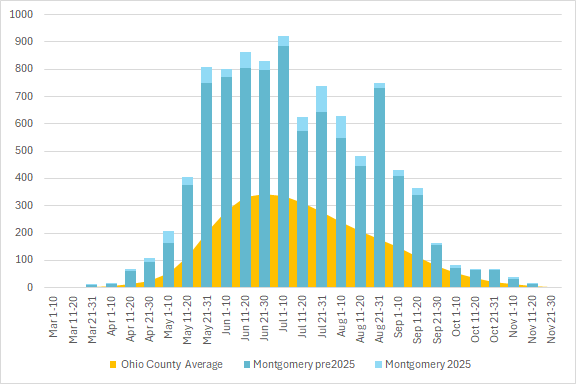
This graph shows the total number of odonata observations for the county in blue, with the average for all Ohio counties in orange. The season is divided into 10 or 11 day segments by Month – basically early-month, mid-month, and late-month.
Page updated 12 January 2026